
Knock Thrice
The Quiet Service | Book 1
Chapter One – The Mountain
James Stuart had always thought there was a useful distinction between courage and stupidity. The trouble was that, halfway up a Scottish mountain in worsening weather, the distinction became increasingly difficult to judge from inside your own decision. The freak late-August cold snap had been an oddity on the forecast until it turned the upper mountain white. Now the wind came hard across the ridge, lifting loose snow and driving it almost horizontally.
James turned his face away from it long enough to check the GPS again. The marker was still there, unmoving, a little over three hundred metres away and lower down the corrie.
“Still nothing?” Rob Haldane asked.
“Still there. Hasn’t moved.”
Rob leaned across to look at the screen, then towards the white-grey emptiness below them. “Could be the phone. Could be sitting in the snow while its owner is already halfway back to Fort William, or in the café wondering why we’re freezing our bollocks off looking for it.”
“The café would be nice.” James put the GPS away. “Less likely.” Rob regarded him for a moment. They had known one another long enough that James could recognise the point at which argument became ritual rather than persuasion.
“You’re going down there,” Rob said.
“We’re going down there.”
“I preferred you when you were an officer. At least then you made stupid decisions sound official. I volunteered for Mountain Rescue, not whatever character flaw makes you enjoy this.”
James smiled behind his neck gaiter. “I don’t enjoy it.”
Rob’s answer was immediate. “Bollocks.”
The radio crackled against James’s chest before he could answer.
“Two, Control.”
He unclipped it. “Two.”
“Search party four has reached the western marker. Nothing found. Visibility deteriorating below eight hundred metres. How are you getting on?”
James looked down the slope again. The cloud was moving quickly now, closing and opening around the mountain in great sheets. He had spent enough time in places like this to know that weather rarely announced the precise moment at which it became dangerous. More often you looked back afterwards and realised you had crossed the line some time ago.
“Phone location is stable,” he said. “Approximately three hundred metres southeast of us and eighty metres down.”
There was a pause.
“Ground?”
James considered the slope beneath them: steep, broken by rock shelves and patches of hard-packed snow, with enough fresh powder gathering in places to make him uneasy.
“Unpleasant.”
Rob gave a quiet snort. Control ignored the editorial comment. “You’ve got forty-five minutes. If you don’t have eyes on by then, come back up. Forecast is worsening.”
“Understood.” James clipped the radio back onto his harness.
“Forty-five,” Rob said. “I mean it. You have a habit of hearing limits as challenges.”
“No, I don’t.”
James started carefully down the slope. Behind him came the crunch of Rob’s crampons.
“That,” Rob said, “was exactly the sort of thing you used to say before making us do something bloody awful.”
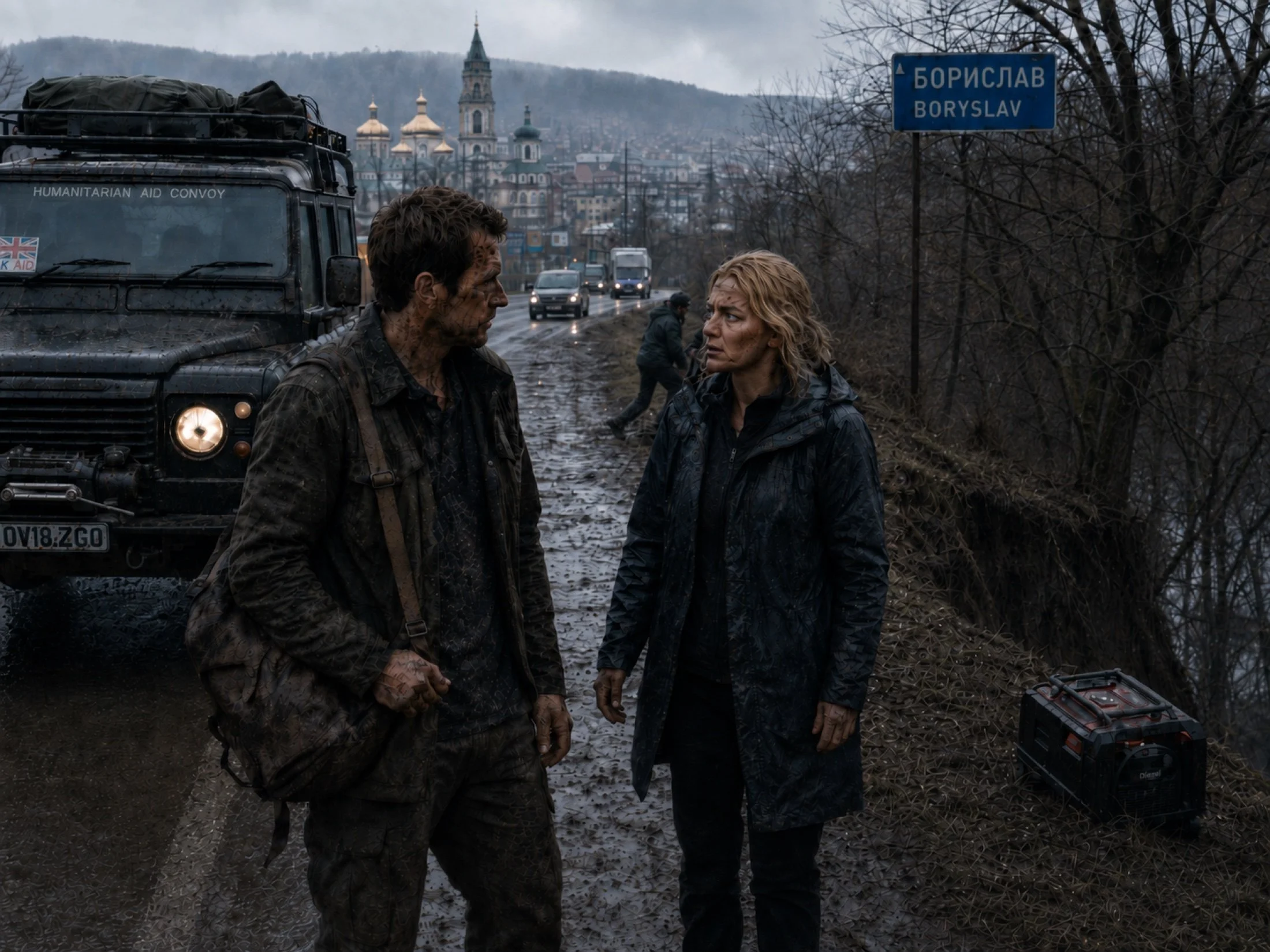
The phrase carried James somewhere else for a moment, to March 2022 and a lay-by outside Rzeszów where Rob had discovered that agreeing to help drive a van of medical supplies to Poland was not, in James’s vocabulary, the same thing as agreeing to stop at the Polish border. James had been out of the regular Army by then and working in consultancy, but the first weeks after the Russian invasion had produced the sort of practical demand he found difficult to watch from a distance. A legitimate aid group needed drivers who could handle long hours, poor roads and the possibility that plans would change without warning. James knew vans, loads, routes and enough people from his service years to understand what he did not know. Rob had answered the telephone, listened to the proposal and said yes before asking the question that would later prove important: “How far east?”
At first the answer had genuinely been Poland. They carried trauma dressings, antibiotics, blankets, batteries and two generators donated by an engineering firm whose managing director had clearly enjoyed the idea of seeing his company name photographed beside something useful. The warehouse near the border was organised chaos, staffed by Ukrainians and Poles who had developed in three weeks the brittle efficiency of people learning a new logistics system while it was already overloaded. One of the Ukrainians coordinating onward movements was Olena Marchenko, a civil engineer who had apparently become a transport organiser because war had created an immediate vacancy for one. She was strikingly blonde, matter-of-fact and considerably more interested in axle loads than introductions. James liked her almost at once for the professional reason that she answered the question he had actually asked.
James expected to unload, sleep and drive home. Instead Olena and the Polish coordinator told them that vehicles were needed for a movement farther east. The cargo would be redistributed, the vans were suitable, and there were people on the Ukrainian side who could use drivers. Rob looked at James across a pallet of bottled water and said, “That look. That is exactly the bloody look.” James told him he could stay. Rob called him several things that did not amount to staying.
The road east was full of traffic moving in both directions for incompatible reasons. Families came west in cars carrying bedding under elastic straps, dogs on laps and possessions chosen too quickly. Ambulances and military vehicles went the other way. At service stations people swapped information with the intensity of a market: which road was open, where fuel remained, which bridge had been damaged, which town was taking arrivals. James’s military experience helped less than people later assumed. Nobody needed him to play soldier. What mattered was that he understood load, route, delay and the point at which recovering equipment became less important than recovering people. The Ukrainians around him understood the rest better than he did.
They met the coach shortly before dusk on a secondary road where spring thaw and heavy traffic had broken the verge above a drainage culvert. Its nearside rear wheels had punched through the edge and the vehicle leaned towards a steep drainage bank, still carrying perhaps forty people, mostly older adults, women and children. The driver had been trying to ease it backwards for long enough that the clutch smell reached James before he reached the vehicle. A local volunteer pointed east, spoke rapidly to the convoy lead, then repeated in English that the route might not remain usable for much longer. Nobody said artillery. Nobody needed to.
James went underneath only far enough to confirm what the angle had already told him. The culvert wall had begun to fail below the axle. Worse, the coach was no longer resting on anything he trusted to remain road. They had two vehicle winches in the convoy and enough recovery gear to pretend at a solution, so James and Rob helped rig the first line while Ukrainians began moving the most mobile passengers towards the high side of the coach. For perhaps thirty seconds it looked as though they might arrest the lean and pull the rear wheels back onto sound ground. Then masonry shifted beneath the chassis with a hard grinding crack and the coach dropped another few inches.
One of the winch lines snapped taut. The van attached to it moved perceptibly on its suspension.
James looked at the culvert, the angle of the coach and the load running through gear that had never been intended to recover a bus. “We’re not recovering it,” he said. “We’re holding it.”
That changed the job. A second convoy vehicle was brought across to give them a redundant restraint, positioned far enough from the failed edge that losing one anchor would not take the other with it. Rob checked the recovery points twice while James got a rope system onto the coach itself. The aisle had become a slope, steep enough that anyone losing their footing would be thrown towards the low-side windows. Most passengers could climb towards the upper emergency exit with help from Olena, the driver and the other volunteers. Two could not: an elderly man whose leg would not take his weight and a woman who had frozen halfway down the aisle after the last movement of the coach.
James clipped himself in before going back inside. Rob followed on a second line, swearing continuously in the calm, conversational manner he reserved for situations he considered genuinely dangerous. The coach shifted once beneath them. Metal complained somewhere under the floor and both men stopped until the restraint settled again. They clipped in and used the ropes to work their way through the coach, now canted so steeply that the floor could no longer be trusted underfoot. James and the driver got the elderly man into a makeshift sling while Rob talked the woman into moving one hand and one foot at a time. Ukrainians outside hauled from the high-side exit. Nobody needed James to command the operation; they needed him to understand what would fail next.
When the last passenger was clear, the driver went back inside with his handwritten list. James caught his sleeve and the man pulled free, furious. It was his vehicle, his passengers and, from the intensity of the response, possibly his entire sense of professional honour. He emerged with an elderly woman’s small case, went back for a carrier bag beneath a seat and checked the rear rows again before allowing James and Rob to get him out.
Rob watched him climb down and said, “He knows the bus isn’t coming, right?”
“He knows.”
“Then why was he still counting bags?”
James looked at the coach, held above the failed culvert by two lines that were now doing nothing except buy time, and understood the answer before he found the words. “Because it isn’t his to abandon.”
Rob glanced at him. “It’s literally his bus.”
“That isn’t what I meant.”
The evacuation created another problem. The people from the coach had to go somewhere, and every useful vehicle was already carrying aid. Boxes came out first and were stacked under tarpaulins for another vehicle to collect. Then James pointed at the larger generator. Olena objected immediately. A clinic had been promised it and she had spent two days making sure it reached the right convoy. James knew exactly what that meant and hated the arithmetic anyway.
“We need the space.”
Olena looked towards the passengers gathering beside the road, then back at the generator. “This goes to clinic.”
“People go first.”
She gave him a look suggesting that she did not require an English engineer to explain that principle, then helped organise four people to manhandle the generator out of the van. There was no time to lower it neatly. They put it beside the ditch, covered it against the weather and marked the location for the collection vehicle following behind. For the rest of the evening Olena referred to it as my generator with enough accusation that Rob began doing the same.
The driver finally climbed into one of the convoy vehicles carrying a child’s coat. He had locked the coach before leaving it, a gesture both absurd and entirely comprehensible. They were fifty metres down the road when one of the restraint vehicles stopped. James looked back. The damaged verge beneath the coach gave way in a long, quiet slump. One line paid out violently before its operator released it; the other held long enough to turn the coach before it slid several metres farther down the bank and came to rest against the broken culvert at an angle nobody aboard would have survived comfortably.
Nobody said anything for a few seconds. Olena looked from the coach to the covered shape beside the ditch.
“People are safe. This is most important. Generator will survive,” she said.
The convoy reached the next distribution point after dark. Nobody fired at them. Nothing exploded nearby. The Ukrainians had done most of the difficult work. James and Rob had happened to possess useful skills at the moment engineering judgement and rescue technique became the same problem. What stayed with James was the moment the job changed. The generator stopped mattering. The people still did.
Later, when Rob was tired enough to become philosophical, he asked whether every trip with James eventually became “something bloody awful”. James said only the memorable ones. Rob told him that was not reassuring. James let that one go.
The missing walker was twenty-two, called Emily Foster, and had messaged her flatmate shortly after midday to say she had lost the path in cloud. Nothing had been heard from her since. Her phone had continued to transmit a location intermittently for almost two hours, wandering enough to suggest poor signal but not enough to suggest that she herself was moving. James had seen the pattern before. Sometimes it meant someone had found shelter and was sensibly staying put. Sometimes it meant the phone was lying somewhere its owner was not. Sometimes there was no good interpretation at all. He tested each step before committing his weight, using the axe to probe where the snow looked suspect. The world narrowed and expanded with the cloud. For a few seconds he could see fifty metres down the corrie, dark rock breaking through the white. Then the mist thickened and visibility collapsed almost to the end of his outstretched arm. That bothered him more than the cold. James had never particularly minded bad weather, but he disliked having information taken away from him.
“James.”
Rob had stopped above him. He pointed. At first James saw nothing. Then, through a thinning fold of cloud, there was a flash of orange below. They moved towards it. It resolved into a rucksack lying on its side beside a rock. James felt the familiar tightening in his chest. Finding equipment without the person attached to it was seldom encouraging.
“Emily!” The wind took the name before James called again, louder. “Emily Foster!”
For several seconds there was nothing. Then, faint enough that James almost thought he had imagined it, a voice came back.
“Here.”
Rob looked at him and they both moved faster. She was perhaps ten metres below the pack, wedged against a shelf of rock where the slope steepened. One leg lay at an angle James did not like. Her hood was pulled tight around a face that had lost most of its colour, but she was conscious and tracking them as they approached. James crouched beside her.
“Emily?” Her eyes focused slowly and she managed a faint “Yeah.”
“My name’s James. This is Rob. Mountain Rescue.”
“I know.”
“That saves time.” The corner of her mouth moved, which James took as a good sign.
Still engaged. He put a hand against the side of her hood and asked how long she had been there. She did not know. When he asked about pain in her neck or back, she shook her head and indicated the injured leg.
“I can see that. Anywhere else?”
She shook her head. Rob was already on the radio, giving Control their position and condition. James checked her pulse, asked the standard questions, watched her responses and tried to keep his voice deliberately ordinary. People took cues from the people helping them. If he behaved as though the situation could be managed, there was a reasonable chance she would believe him. She had slipped on the slope above and fallen perhaps six metres, badly injuring her left ankle and possibly the lower leg. She had managed to drag herself against the rock before the cold began taking choices away from her.
“Am I going to lose my foot?” she asked.
“No.”
She looked at him sharply. “You don’t know that.”
“No,” James admitted. “But you’re warm enough to argue with me, which is encouraging.”
That produced a brief laugh, immediately followed by a wince. Rob leaned closer. “Control wants us to stabilise and hold. South team’s coming across. Forty minutes minimum.” James looked back uphill. The cloud had thickened again and the light was beginning to flatten towards evening.
“Helicopter?”
Rob shook his head. “Not in this.” Emily began to shiver harder. They worked quickly, getting insulation beneath her, wrapping her in additional layers and splinting the injured leg as best they could. Rob unpacked the emergency shelter and the three of them crowded beneath it while the wind battered the fabric and tried to wrench it from their hands. For a while their world shrank to red nylon, breath condensing in the cold air and the tick of Rob’s watch. James kept Emily talking. York, she told him. A master’s degree. Environmental economics.
“That sounds cheerful,” James said.
“It isn’t. Career prospects aren’t either.”
“Excellent. University working exactly as intended.”
This time she laughed properly. Something struck the shelter from outside with enough force to make Rob look up.
“Wind’s turning.”
James checked his watch. Twenty-three minutes since they had found her. Then he heard the sound underneath them. A low, brittle crack. He knew what it was before Rob spoke.
“Move.”
The shelf beneath the shelter shifted, not dramatically, perhaps an inch. Enough. Then it shifted again. James tore the fabric aside and the wind rushed in.
“Emily, we’re moving you now.” Her expression changed at once, but Rob was already reaching for the anchor and there was no time to explain. James got his arms beneath Emily and tried to judge the quickest way of getting her clear without worsening the injury. The mountain made the decision for him. The snow beneath his left boot dropped away. Rob shouted something James did not catch. The slope seemed to tilt under them as a whole section began to move. There was no great cinematic roar, no wall of white bearing down from above. The surface simply ceased to be reliable ground. Emily slid towards the edge of the shelf. James went after her. His hand closed around the strap of her harness. Something struck his shoulder, hard enough to spin him, and his axe vanished out of sight. Then all three of them were moving. James hit snow, then rock, then snow again. He kept his grip on Emily’s harness through instinct more than judgement and twisted, trying to get himself below her. For one instant he saw Rob higher up the slope, fighting for purchase. Then the cloud swallowed him. The slope ended.
There was a peculiar fraction of a second in which James understood exactly what had happened before gravity completed the explanation. Emily had stopped somewhere above him. He still had no idea how. His right glove was torn. His radio was gone. He had lost the axe. Then he registered the rock below. A long way below. He fell. Someone caught his wrist. The force nearly tore his shoulder from its socket. James struck the rock face hard enough to drive the air from his lungs and hung there, boots scrabbling uselessly against stone. For several seconds his entire universe consisted of pain and the effort required to breathe. Then he looked up. A man was holding him. James stared. The Stranger stood perhaps a metre above him on a projection of rock so narrow that James would have hesitated to put a boot on it while roped. The man wore no harness, no crampons and no helmet. There was no rope securing him to anything. A dark coat moved around his legs in the wind, wholly unsuitable for the conditions. His hand around James’s wrist felt immovable.
“Other hand,” the man said.
James blinked. “What?”
“Unless you have developed an attachment to the view.”
James reached up. The Stranger caught his other wrist and simply pulled. There was no visible bracing or strain. James weighed more than twelve stone before boots, pack and cold-weather clothing, yet the man lifted him onto the ledge with no more effort than if he were hauling a child over a garden wall. James landed on his knees and stayed there for a few seconds, breathing hard and staring at the stone between his gloves. Training returned before comprehension did.
“There’s a woman above me. Injured. Another rescuer.”
“Both live,” the Stranger said, and confirmed that he had seen them.
The Stranger was perhaps thirty, although something about his face made the estimate feel unreliable. Dark hair, pale skin, fine features. Handsome, James supposed, in the abstract way one might notice later rather than while hanging above a fatal drop. His eyes were very dark. James took them for brown at first, almost black in the poor light, but when the Stranger looked directly at him the impression changed. There seemed to be depth behind them that an eye ought not to possess, tiny points of cold light suspended somewhere beneath the surface. For one disorienting instant James thought of starlight reflected in deep water. Then the man blinked and they were merely dark eyes again. He was not breathing heavily. His hair was dry. James looked at the coat again. “Who are you?” The man did not answer. Instead he tilted his head, studying James with an intensity that made him uncomfortable. Something shifted in his expression. Recognition. James knew what ordinary recognition looked like. A former colleague encountered in a station. Someone from school glimpsed across a pub. This was different. The Stranger looked as though he had opened a door expecting an empty room and found someone waiting on the other side. His hand closed around James’s forearm.
Heat moved through James with such sudden force that he almost pulled away. It was followed by pressure, a sensation like standing beneath high-voltage lines in damp weather, except that it seemed to come from inside his bones. The Stranger released him at once.
“No.”
James frowned. “No what?” The man’s composure slipped.
“What is your name?”
“James.”
The Stranger’s expression hardened. “Your name.” There was something in the question that made James hesitate.
“James Stuart.”
Silence followed. James became aware that the wind had stopped. Not eased. Stopped. A moment earlier it had been tearing across the face of the mountain. Now the air was completely still. There was no loose snow skittering over the rock, no cloud boiling past them, no distant shouting from Rob or the rescue team. The Stranger stared at him and said something quietly in a language James did not recognise. James put a hand against the rock to steady himself. It was warm. He looked down. Green moss grew between his fingers. For several seconds he simply stared at it. There had been no moss here. At this height, in these conditions, there could not have been moss like this. He pulled his hand away and looked beyond the ledge. The mountain had disappeared. Below them lay a forest. Not the sparse forestry and scattered Scots pine he knew from the Highlands, but woodland so vast and dense that his eye could not find an end to it. Great trunks rose out of darkness and mist, their upper branches spreading beneath a sky coloured green and gold like light through old glass. James stood too quickly and felt the world pitch.
“What the fuck?” The Stranger seized the front of his jacket before James could step back.
“Do not move.”
James stared past him at the impossible forest. “Where are we?”
“The Betwixt.”
“Betwixt what?”
The man’s eyes shifted towards the forest. Something moved among the trees below. James could not see it clearly, only the displacement of branches and the suggestion of immense size. Wood cracked somewhere in the mist. Then a sound rolled through the woodland, low and resonant enough that James thought first of a hunting horn. The resemblance did not survive the second note. There was breath in it, or pressure, something organic forcing air through a chamber far larger than any human chest. A second call answered from much farther away and yet seemed to arrive from somewhere behind James’s shoulder. The Stranger swore. That, at least, was reassuringly human.
“A horn?” James asked.
“No.” The Stranger listened for another moment. “A call.”
Whatever was communicating out there did not appear interested in them. The Stranger pulled James closer. “We are leaving. Close your eyes.”
“Excellent. No.”
The man looked genuinely incredulous. “You are hanging between worlds and choose this moment for stubbornness?”
“I’m not closing my eyes.”
“Then do not blame me for what follows.”
He stepped sideways. There was nowhere to step. James opened his mouth to object. The world folded. Later, he would struggle to find any other word for it. There was no tunnel, no flash, no sense of travelling from one place to another. For a fraction of a second he seemed to see the forest simultaneously from above, below and somewhere inside it. More than that, he saw lights moving beneath the earth. Lines. Thousands of them, crossing the land in great luminous threads. Some burned bright enough to hurt his eyes. Others were faint or broken, interrupted by dark gaps that felt wrong even before he understood what he was looking at. They ran beneath rivers and mountains, intersected beneath hills, threaded through towns and cities like illuminated veins.
Far to the south and west, something enormous slept beneath red earth and stone. James felt it breathe. Then his face hit snow. Wind battered him so violently that for a moment he could only lie there. Someone was shouting his name.
“James!”
Rob. James rolled onto his back and stared at the grey sky. Cloud. Snow. Rock. Normality had never looked so beautiful. Rob stumbled towards him, moving as fast as the slope allowed.
“You absolute fucking idiot.” A laugh escaped James before he could stop it. It came partly from relief and partly from the sheer absurdity of everything that had happened. Rob dropped beside him and gripped his shoulders, checking quickly for obvious injury. “You all right?”
“I think so.”
“You fell off the bloody edge,” Rob said. “Then how the fuck did you get up here?”
“I noticed the first part.”
James’s laughter stopped. “Up?” Rob pointed downhill. Only then did James understand what was wrong with the geography. The broken edge of the snow shelf lay below them, perhaps six or seven vertical metres down the slope and thirty metres away through the cloud. Rob had seen him disappear over that edge. James remembered falling from it. Yet he was now sitting above it, on ground he could not possibly have reached without climbing back past Rob. He turned towards the rocks beside him. There was no Stranger.
“Where’s Emily?”
“Team’s got her. They’re a couple of minutes behind me.” Rob was still looking at him. “I thought you’d gone over.”
“I did.”
“I saw you go. There is no way you climbed back past me, so how did you get up here?”
“I know.” James looked around again.
There were no footprints other than James’s own disturbed trail through the snow. He pointed towards the rock face. “There was a ledge.”
Rob followed his finger. There was no ledge. The wall dropped almost sheer into cloud. James felt something cold settle in him that had nothing to do with the weather.
“He caught me.”
Rob stared at him for several seconds, then raised one gloved hand and made a small circling gesture beside his helmet.
“Oh, fuck off.”
Rob’s expression sobered. “I’m serious now. You’ve had a fall. We get you checked for concussion.”
“That too.”
Shapes were emerging from the cloud now: the first members of the rescue team working their way across the slope towards them. James looked down at his right wrist. Dark bruising was already forming around it. Three elongated marks on one side. One on the other. A thumb. He counted them twice. Three fingers. He pulled the glove back over them. Someone had caught him. Whatever else had happened, that much was real.
------------------------------------------------------------------------
At 9.14 pm that evening, Helen Ward was halfway through an email about diesel-generator resilience when a notification appeared in the corner of her monitor. She ignored it. The Cabinet Office had an apparently limitless ability to generate urgent correspondence about matters that were neither urgent nor, in several cases, properly correspondence. Helen finished the paragraph she was writing, changed dependant to dependent, then opened the notification. The subject line read:
AUTOMATED REFERRAL: EXCEPTIONAL INSTRUMENT 7.3
Helen sat back slightly. She had worked in the Constitutional Continuity Secretariat for four years. She had seen Exceptional Instruments referenced in old files, discussed in induction briefings and mentioned in the sort of procedural annexes nobody expected ever to use. She had never seen one trigger automatically. The message contained a Police Scotland incident reference, a Mountain Rescue report and a preliminary technical note describing a telemetry discrepancy associated with one member of the rescue team. There had been one casualty, now stable, and an unexplained displacement following a fall. Helen sighed. Corrupted GPS, almost certainly. Possibly damaged equipment. Some enthusiastic analyst had allowed an automated system to escalate something it did not understand.
She scrolled down.
Individual: STUART, James Alexander
The monitor flickered. Helen stopped. A box appeared in the centre of the screen. It did not resemble Outlook, the case-management system or anything else installed on the machine. Plain white background. Black text.
LINEAL REVIEW REQUIRED
Helen stared at it. After several seconds she moved the cursor towards the box. It disappeared. She checked the audit log and found nothing: no application launch, no system notification and no record that the message had ever appeared. Helen picked up her secure phone, then paused. Word had opened behind Outlook. She had been working on a briefing note earlier in the evening, but she had closed the document before starting the email. Now it sat on the screen with the insertion point blinking halfway through a sentence. Helen put the phone down. The sentence read:
No evidence exists of anomalous magical activity within the United Kingdom. She watched the red spellcheck underline beneath magical disappear. Then, without any movement from her hands, a single letter appeared in the word.
magickal
Word accepted the spelling without complaint. Helen stared at it for several seconds, then very deliberately moved her hands away from the keyboard. The building around her was almost silent at that hour. When she looked back at the screen, the insertion point had moved to a blank line beneath the altered sentence.
James Alexander Stuart.
She opened the bottom drawer of her desk. Inside lay a paper file she had inherited from her predecessor with three explicit instructions: it was not to be destroyed, it was not to be digitised, and it was not to be opened unless an Exceptional Instrument required it. Until that moment, Helen had assumed the instructions were simply another fossil of institutional caution. She lifted the file onto the desk. Its cover was faded and soft at the edges. The title had been written by hand in blue ink many years ago.
THE CROWN IN ABEYANCE
Helen looked at the title, then at the impossible spelling on her screen. For the first time since taking the post, she did not feel irritated by the Secretariat’s habit of preserving rules nobody could explain. She felt afraid. For several seconds, she left the file closed beneath her hand.